
Blog

Science in the kitchen: 10 scientific secrets that happen while cooking every day

The science of cooking isn't just a fun concept; it's a reality we experience every time we start cooking. Every time you enter the kitchen, dozens of chemical and physical reactions occur, often unnoticed. Food changes color, aroma, and texture—all due to precise scientific processes that influence the final result. Understanding this science can help improve your cooking results and avoid many everyday mistakes.

Understanding these phenomena not only makes cooking more enjoyable, but also helps to avoid many mistakes and get better results every time.

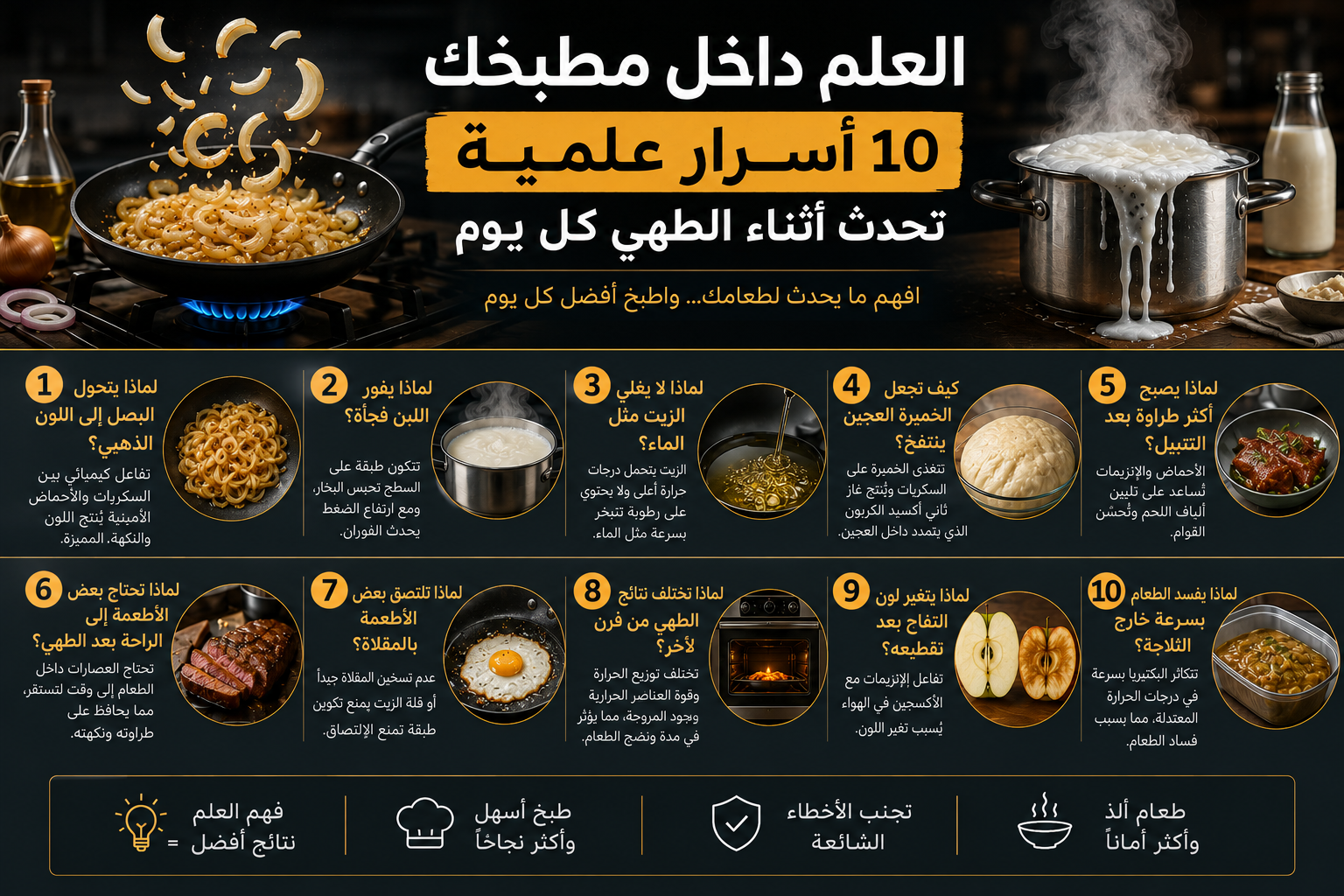
Why do onions turn golden?

When onions are heated, the natural sugars inside them begin to react with amino acids, a process known as the Maillard reaction.

This reaction gives onions their distinctive golden color and forms compounds responsible for the rich flavor and delicious aroma that appears during cooking.

The more you cook over a medium heat and for a sufficient amount of time, the better the result, while high heat may cause the onions to burn before this reaction is complete.

Why does the milk suddenly boil over?

Milk differs from water in its composition, because it contains proteins, fats and sugars.

When it boils, a thin layer forms on its surface that traps the steam underneath. As heating continues, the steam pressure increases until it pushes this layer upwards, causing a sudden effervescence.

Therefore, it is advisable not to leave milk on the stove unattended.

Why doesn't oil boil like water?

Water boils at about 100 degrees Celsius, while oil can withstand much higher temperatures.

Water also contains a large amount of moisture that quickly turns into steam, while oil does not go through the same stage as easily, so we do not see it boil in the same way.

But this does not mean it is less hot; the temperature of the oil during frying may reach more than 180 degrees Celsius.

How does yeast make dough rise?

Yeast is a microscopic living organism that feeds on the sugars found in dough.

During this process, carbon dioxide gas is produced, which accumulates inside the gluten network, causing the dough to expand and increase in size.

Therefore, the dough needs sufficient time to ferment in order to obtain a light and fluffy texture after baking.

Why does meat become more tender after marinating?

Seasoning not only adds flavor, but also helps to change the texture of the meat.

Some ingredients, such as yogurt, lemon juice, or vinegar, contain acids and enzymes that help soften surface tissues, making meat more tender when cooked.

However, leaving the meat in the marinade for too long can have the opposite effect in some recipes.

Why do some foods need to rest after cooking?

When you take a piece of meat or chicken directly off the fire, the juices are still moving inside it.

If it is cut immediately, a large amount of these juices come out, and the meat appears drier.

Leaving it for a few minutes allows the juices to redistribute inside it, which preserves its freshness and flavor.

Why do some foods stick to the pan?

Sticking often occurs when the pan does not reach the proper temperature, or when an insufficient amount of oil is used.

The type of pan surface also plays an important role, as some materials reduce sticking more than others.

Therefore, it is always preferable to heat the pan first, then add the oil, and then place the food in.

Why do cooking results vary from oven to oven?

You can set the oven to 180 degrees Celsius, but the result will vary from one appliance to another.

This is due to differences in heat distribution, the size of the internal cavity, the power of the fans, and even the location of the heating element.

Therefore, some recipes may require a slight adjustment in time or temperature depending on the type of oven used.

Why does an apple change color after being cut?

After cutting apples, their cells are exposed to the oxygen in the air.

A natural enzyme inside the fruit reacts with oxygen, causing the surface color to change to brown.

To slow down this process, a few drops of lemon juice can be added, as its acidity reduces the activity of this enzyme.

Why does food spoil quickly outside the refrigerator?

Bacteria multiply rapidly at moderate temperatures, especially if cooked food has been left out of the refrigerator for a long time.

Therefore, food safety experts recommend not leaving food at room temperature for long periods, but rather refrigerating and storing it properly to maintain its quality and safety.

What can we learn from these phenomena?

Behind every step in the kitchen is a scientific explanation that helps us understand what happens to food during cooking.

When we know the reason for the change in color, texture, or smell, it becomes easier to improve the result, avoid mistakes, and approach recipes with greater confidence.

Cooking is not just about following steps; it's a fun combination of experience and science.

These phenomena may seem like a normal part of our daily lives, but in reality, they are the result of subtle interactions that take place every minute we spend inside the kitchen.

The more we understand these interactions, the easier, more precise, and more enjoyable food preparation becomes, whether you are cooking a quick meal or a new experience for your family.

Every time you enter the kitchen, remember that behind every smell, every color, and every flavor lies a scientific story worth discovering. With this understanding, your cooking experience will become more enjoyable and professional each time.

Leave a comment

Your email address will not be published. Required fields are marked *