Almost every day we use kitchen appliances without giving them much thought.
We turn on the stove to prepare coffee or lunch, we open the oven to prepare a new meal, and we turn on the extractor fan when steam and smells start to spread.
Then the cooking is finished.
We wash the dishes, wipe down the kitchen surface, and leave the place.
As for the appliances themselves, we rarely get a moment to think: Do they need cleaning? Are there grease build-up on them? Is there a part we haven’t paid attention to in a while?
And this is where the problem begins.
Devices that operate every day not only need to work when we press the power button, but also need a certain amount of attention so that the user experience remains comfortable, their appearance remains good, and the chances of dirt and residue accumulating over time are reduced.
The device does not get tired in one day
It is rare that you wake up one morning to find that your kitchen appliance has suddenly become faulty.
What usually happens starts with small details.
There's a drop of oil here.
There are leftover food pieces.
Steam repeats itself day after day.
A thin layer of fat that we do not notice at first.
Then the cooking process is repeated again, and a new layer is added on top of the old one.
After a while, cleaning the place becomes much more difficult than it would have been if these residues had been dealt with in time.
Therefore, taking care of devices is not only related to appearance.
Regular maintenance also helps to prevent the buildup of dirt that can become more difficult to remove over time.
The stove sees everything
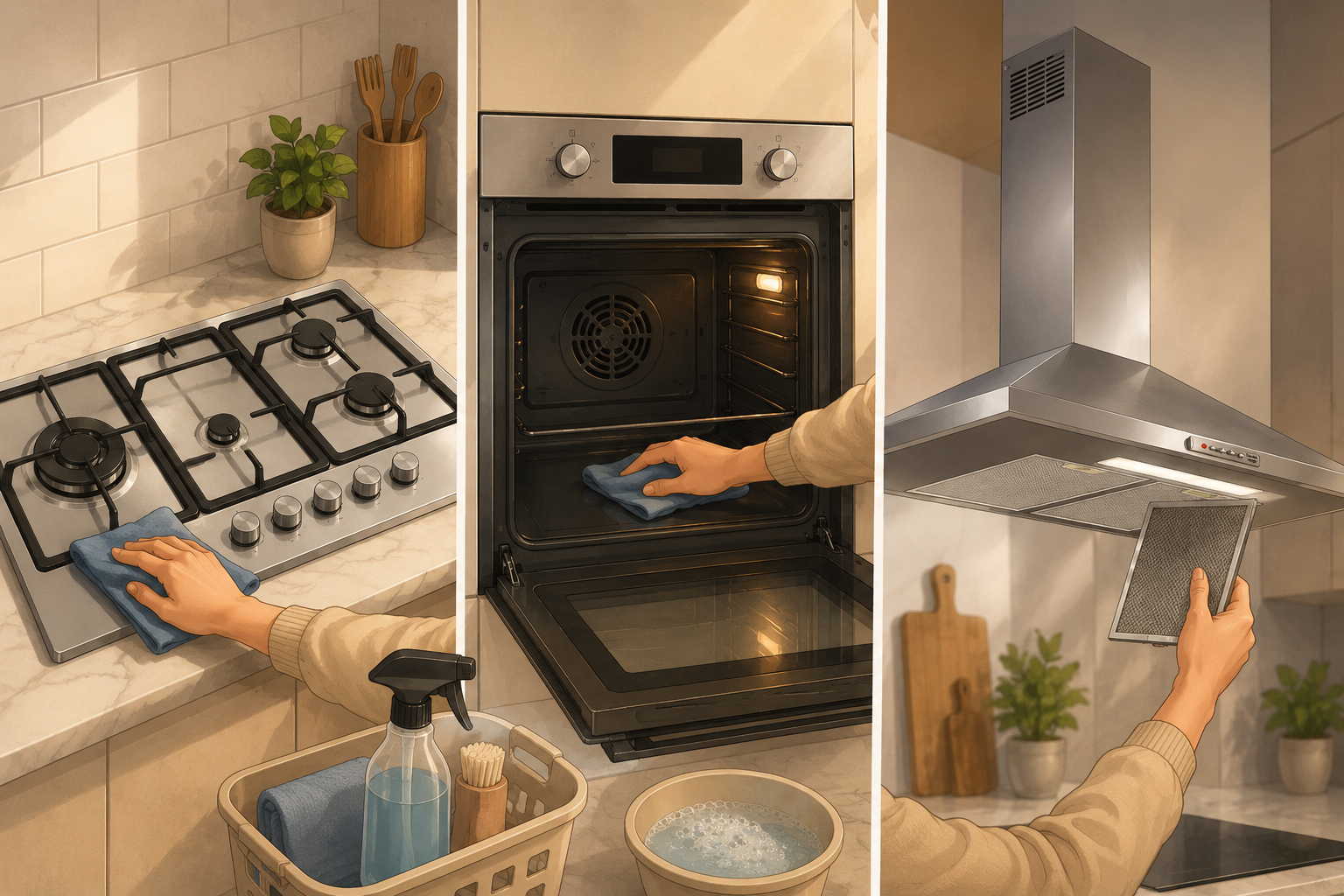
The stove is perhaps the appliance that deals most directly with the details of everyday cooking.
Volatile oils, sauces, boiling and spilling water, and food scraps… all can reach its surface during meal preparation.
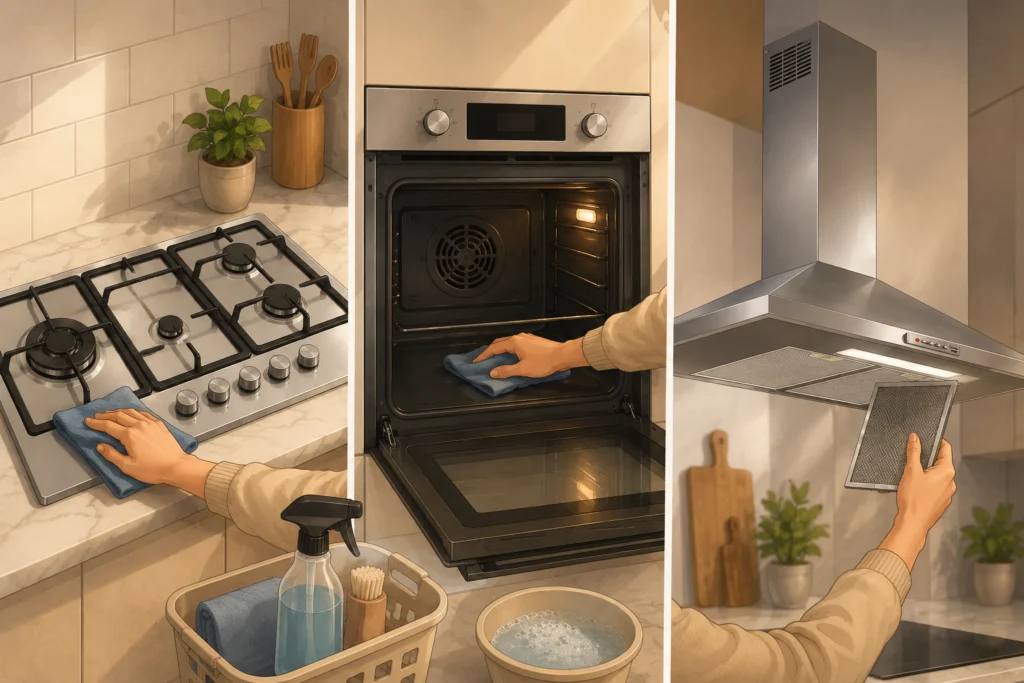
Therefore, cleaning it after it has cooled down and become safe to handle can save a lot of effort later on.
For glass or ceramic cooktops, it's important to use the appropriate cleaning method and materials, and to avoid abrasive tools that could cause scratches or damage. Some manufacturers' guidelines recommend regular cleaning and using cleaners specifically designed for glass and ceramic surfaces when necessary.
The idea is not to spend half an hour after every meal cleaning up.
Sometimes a few minutes are enough to prevent the residue from turning into a bigger problem.
And the oven… the place where we hide traces of cooking
The oven is slightly different.
Because we don't see most of what happens inside it all the time.
We place the tray.
We close the door.
We are waiting.
But during cooking, fats may splatter, some sauces may spill, and food residue may accumulate on the interior surfaces.
With repeated use, these residues can become more difficult to clean.
Therefore, it is best not to wait until the oven becomes very dirty before taking care of it.
The guidelines recommend using warm water, a suitable cleaning solution, and a damp cloth to clean the oven, avoiding the need for homemade mixtures or unnecessary materials.
Oven glass deserves special attention
There is a part of the oven that we use all the time without considering it part of the cleaning process.
Glass.
It is the window through which we monitor the food.
But over time, traces of grease and vapor can accumulate on it, reducing the clarity of vision.
Keeping oven glass clean isn't just about looks; it makes monitoring food while cooking easier.
The guidelines indicate that oven glass can be cleaned using a suitable glass cleaner and a soft cloth or microfiber cloth, dealing with stubborn deposits gradually rather than scrubbing them vigorously.
The extractor fan works silently… but it collects traces of cooking
As for the extractor fan, its story is different.
It is the device that works in the background while food is being prepared.
It helps to deal with fumes, odors, and volatile fats resulting from cooking, but at the same time it is constantly exposed to these elements.
Therefore, leaving the extractor fan for long periods without cleaning can lead to the accumulation of grease on the parts exposed to cooking fumes.
This highlights the importance of paying attention to filters and parts that can be cleaned according to the manufacturer's instructions.
The more cleaning becomes part of the routine, the easier it is to deal with accumulated grease than to let it accumulate for long periods.
Quick cleaning is better than delayed cleaning
There is a big difference between wiping away a small trace after using the device, and trying to remove layers that have accumulated over weeks.
Therefore, the best time to take care of appliances can be when the cleaning process is still simple.
But there is an important point:
Do not clean the device while it is hot unless the company's instructions prohibit it.
Wait until it is safe to handle, then use the appropriate cleaning method for the type of surface and device.
The goal is not to clean the device in any way, but to clean it in a way that preserves it.
Not every cleaner is suitable for every device
A common mistake is believing that the strongest cleaner is always the best.
But the surfaces are different.
Glass is not like stainless steel.
Ceramic surfaces are not like painted surfaces.
Some chemicals or abrasives may leave marks or cause damage to some finishes.
Therefore, it is always best to refer to the appliance's instructions before using any cleaning product.
The guidelines for some appliances warn against abrasive cleaners and certain compounds that can affect stainless steel or various finishes.
Don't wait for the problem to appear
Taking good care of your devices doesn't mean waiting until a malfunction occurs.
If you notice unusual buildup, a change in performance, an abnormal smell, or a part that has become difficult to use, it is best not to ignore it.
Sometimes the problem is simple and can be dealt with by cleaning or referring to the user manual.
In other cases, you may need a specialist technician.
The important thing is that ignoring doesn't become a habit.
Devices also love routine
We love routine because it makes our lives easier.
The devices benefit from the same thing.
Instead of waiting until the oven is extremely dirty, make cleaning it part of your kitchen care schedule.
Instead of ignoring the filters for a long time, check the company's instructions to find out how to clean them and when to do so.
Instead of leaving food scraps on the cooking surface, deal with them when it is easy and safe to clean.
These small details do not require a huge effort, but they make a clear difference over time.
Care doesn't mean having devices shine all the time
It is also important not to overdo the idea of cleaning.
The kitchen is a place to use.
The appliances will be exposed to food, steam, and fats because they are part of the cooking process itself.
Therefore, the goal is not for the oven to look as if it has never been used.
The goal is to prevent the effects of normal use from turning into neglected accumulations.
There is a big difference between a device that is used daily and is cleaned and cared for regularly, and a device that is left to accumulate the effects of use over long periods of time.
When you take care of the device… you feel the difference while using it
There's a different feeling when you open a clean oven.
And when you find the cooking surface tidy.
When the extractor fan is clean and the filters are regularly maintained.
The kitchen itself looks more comfortable.
The cooking process becomes more enjoyable.
This is the aspect we sometimes forget.
Appliance care is not just about the appliances themselves, but about the experience we have every day inside the kitchen.
A good device needs a user who cares about it
Even the best devices can't take care of themselves.
You may own an oven with excellent capabilities, a practical stove, and a powerful extractor fan, but how you use and care for these appliances remains an essential part of the experience.
Read the instructions for use.
Find out the appropriate materials for cleaning your device.
Do not use tools or cleaners just because they worked with another device.
Address any abnormal problems early on.
These simple habits will make your relationship with kitchen appliances more comfortable in the long run.
The kitchen is not just about appliances
Ultimately, the appliances in the kitchen are not just pieces of metal and electronics.
Each of these devices is involved in daily details that are repeated dozens of times.
The oven that bakes the family meal.
The stove on which lunch preparations begin.
And the extractor fan that works during frying and grilling.
These devices exist to make our lives easier, so it's only natural that we give them some attention in return.
We may not think much about the devices that operate every day.
We press the button, we use it, and then we leave the kitchen.
But real care begins with the small details we do between each use.
Proper cleaning.
Correct usage.
Do not leave the remains for long periods.
Refer to the company's instructions when we need to know the proper way to care for the device.
Because devices that operate every day deserve to receive some attention every day as well.
In the end, you may not notice the effect of this care after a day or two, but you will feel its value over time, when your kitchen remains more tidy, your appliances more ready for use, and the cooking experience itself more comfortable.
Take care of your kitchen appliances as you would the rest of your home; simple, regular maintenance today can save you a lot of effort later.